The damage you can't see: frame and unibody problems after a collision
Door gaps, a pull to one side, and strange tire wear can all point to structural damage that no amount of paint will fix.
October 14, 2026 · 4 min read
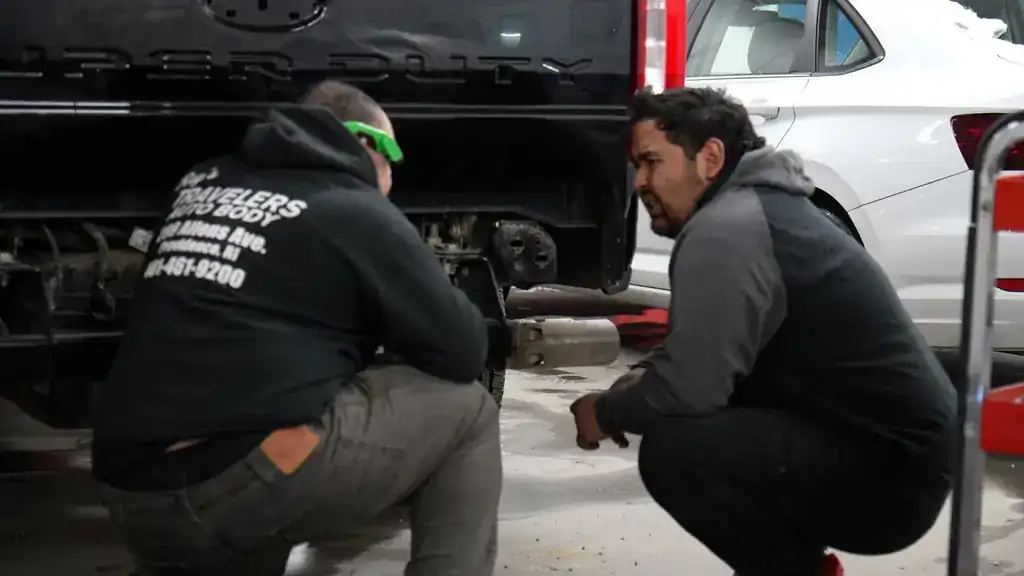
Some collisions announce themselves with crushed metal and broken glass. Others leave a car that looks almost fine: a scuffed bumper, a small dent, nothing dramatic. Then, weeks later, the steering feels off or a door doesn't close the way it used to. What you're feeling can be structural damage, and it's one of the most important things a good body shop looks for. Cosmetic repair makes a car look right. Structural repair makes it be right.
What unibody means for you
Most passenger cars and SUVs on the road today are built as a unibody. Instead of a separate heavy frame with a body sitting on top, the body and the structure are one welded assembly. Rails, pillars, floor pans, and crossmembers all work together, and they're engineered to hold the suspension in place and to crush in particular ways during a crash so the energy goes where it should.
That design is clever, and it also means a hit in one corner can travel. Force goes through the structure and can leave a twist or a bend somewhere you wouldn't think to look. A tweak of a few millimeters in the wrong place can change how the wheels sit, how the doors close, and how the car behaves in the next accident.
Signs something's out of line
You don't need to be a technician to notice the early warnings. Here are the ones we hear about most from customers.
- Uneven gaps around the hood, trunk, or doors, wider at one end than the other
- A door or hood that's hard to latch or that rubs when it closes
- The car pulls to one side on a straight road, even with the wheels aligned
- Tires wearing unevenly or faster on one edge, especially after a hit
- The steering wheel sitting off center while you're driving straight
- Odd wind noise or water leaks that weren't there before the accident
None of these proves frame damage on its own. A worn part or a bad alignment can cause some of them. But if any of them showed up after a collision, even a minor one, it's worth having the car measured before you decide it's nothing.
How measuring against factory dimensions works
Every unibody has published dimensions: precise distances between specific points on the structure, set by the manufacturer. Measuring means comparing your car to those numbers. Instead of judging by eye, a technician mounts the car securely, hooks it up to measuring equipment, and checks control points across the underbody and the upper structure.
In our shop that equipment is a laser uni-body aligner that returns body dimensions back to exact factory specifications. The measuring tells us where the car is out of line and by how much, in three dimensions. If it needs pulling, the technician applies controlled force to the structure and measures again, and again, until the numbers come back where they belong. It's not a single big yank on a chain. It's patient work that stops when the measurements say so.
Our technicians are I-CAR trained, which matters here because structural repair isn't a place for guesswork. Manufacturers publish procedures for what can be straightened, what has to be replaced, and how replacement sections are joined. Following them is what a proper repair looks like.
Why it matters even if the car drives fine
It's tempting to skip this. The car starts, it drives, the dent is small, and money is tight. But structure that isn't back to spec can show up later in ways that cost far more. Tires wear out too soon. The alignment never quite holds. Doors and panels that were refitted over a bent structure never sit right. And a car that's been in a crash needs its crumple zones to do their job again if there's a second one.
A structural problem is also easier to deal with early. If it's measured and documented right after the collision, you have the measurements in hand when you talk with your insurer. Ask them how they handle structural findings. We'll deal with the paperwork on our side.
What to do if you're not sure
If your car has been in a collision and something feels off, don't wait for it to get worse. Bring it by Ray's Travelers Auto Body at 299 Allens Ave, or call (401) 461-9200. We'll look it over, measure it if it needs measuring, and tell you plainly what we find, whether that's a clean bill of health or a repair you'll want to know about. If the car isn't safe to drive, we can tow it in. All repairs on the body come with a lifetime warranty for as long as you own the vehicle.
Ray's Travelers Auto Body, (401) 461-9200
Call (401) 461-9200More articles
Hit and run in Providence: what to photograph and write down first
The first hour after a hit and run decides how smooth the rest goes, and most of it is just photos, notes, and two phone calls.
How your body shop and your insurance company actually work together
You shouldn't have to carry messages between the shop and your insurer, and here's how it works when nobody's dropping the ball.